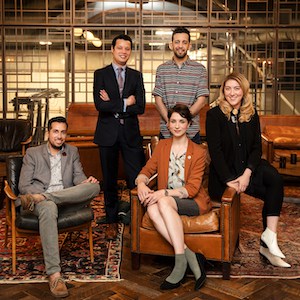
 Beverage Roundtable Participants (clockwise from top): Patrick Mays, Mercedes O’Brien, Emily Mitchell, Matthew Williams and Samuel Gamble.
When it comes to restaurants, what makes people come back again and again? The food and the ambiance, of course. The quality of service, for sure. But a solid beverage program is not to be overlooked.
Whether it’s a warm cup of coffee, a cold beer, a creative cocktail or a perfectly poured glass of wine, drinks help make your restaurant a gathering place. A well-thought-out beverage menu can be a great driver of profit, and it can also create positive word of mouth and good social media exposure for your restaurant. Tastes change, though, so if you don’t know what people want to drink today, they may spend their dollars elsewhere.
That’s why we met with five leaders in Georgia’s beverage world to talk about trends in the industry, how to retain staff and more as part of our 2020 Beverage Roundtable.
The event was held at Bold Monk Brewing Co., part of Brewed to Serve Restaurant Group owned by GRA members Alan and Cindy LeBlanc. The brewery opened in December 2019 in Atlanta’s burgeoning Westside Beer District and seeks to provide a welcoming gathering place throughout the day and into the evening. The former warehouse space has been transformed into an inviting restaurant and brewery, with a second floor that has a cozy library feel and a soon-to-open beer garden out back for those warm weather patio days to come.
Attendees were: Samuel Gamble, beverage manager and head sommelier at Atlas and The Garden Room; Patrick Mays, service and beverage manager for Ladybird Grove & Mess Hall; Emily Mitchell, assistant manager, and Mercedes O’Brien, bar manager, both at Cold Beer, a Red Beard restaurant; and Matthew Williams, general manager of Bold Monk Brewing Co., part of Brewed to Serve Restaurant Group Inc.
Following is their conversation, edited for space and clarity.
RI: What are some trends you’re seeing in 2020?
Emily Mitchell: People have been asking us for experiential cocktails. That is a cocktail that changes over time or provides some kind of narrative or experience over time. Oftentimes that’s as simple as an ice program, and Mercedes has created a really stunning and intense ice program at Cold Beer.
Mercedes O’Brien: That experimental style of cocktails is not new by any means. There’s people who have revolutionized that way before we started bringing it on at Gunshow or Cold Beer. But it’s become a broader spectrum that people are experimenting with at their bars, and our guests are looking for that. Over the last decade or so, it’s been the revival of the classic cocktail, and here’s your parameters that you work in. Now you’re starting to see people who have had that tutelage and expanded beyond it and are really making it their own. And our guests are looking for that and seeking it out, which I think is very interesting.
RI: Do you think that’s driven by social media, or do they really want to experience something different?
EM: I don’t think those are mutually exclusive. You can be inspired by social media and want a genuine experience. That’s the way I read your [Mercedes O’Brien’s] cocktails. They’re not just about the face value.
MO: To be exceptional, you have to do it on both ends. There’s nothing good about a chair that’s beautiful but collapses under your weight. You have to deliver on both. Especially with the way people talk online through social media, they’re not afraid to hold back what they really think about it. You really have to be prepared for that.
Matthew Williams: I built my cocktail program based on that mindset. We’re a brewery. I’m here to sell a lot of beer. My profit margin on beer is excellent compared to liquor or wine.
What’s going to happen nine times out of 10 here is that if six people walk in, five of them are going to order a beer and one is going to order a cocktail. So I want that speed of service, and I want that cocktail to take almost the same amount of time.
So how do I take a cocktail that is perceived as a batch cocktail and maybe not as elegant? Add in different ice cubes, different tea inside the ice cubes. When you infuse that flavor in, it’s exciting to start drinking and have one flavor profile and then slowly release a different flavor.
Samuel Gamble: One standard that’s always the most difficult for bar and lounge is garnishes. Because what was a proper, polite or visually exciting garnish a few years ago is not the same thing as what it is today. You can’t just serve a lime on a gin and tonic. You can’t just serve a lemon with a vodka soda. You have to make it playful, you have to make it whimsical. The guest experience factor has to be there.
When I first started, batching was something we were almost forced to do out of habit, because we cared more about the guest getting their drink on time. That was what the most important thing for guest satisfaction – that they could get that drink on time, the drink was balanced and it was consistent every single time. Garnishes are becoming extremely popular, at least on our end. Also low alcoholic cocktails are now being requested, too. Guests are wanting to experience multiple cocktails over time, and what that’s telling us is intoxication is not the goal anymore. So we’re able to have so much more fun with our guests because we can give them three to four options over the course of their experience.
Patrick Mays: Absolutely. The low alcohol trend is 100% for this summer. That and the low-calorie beers. We’re coming up with a new drink list, and we’re going to have a specific section just for no alcohol and low-alcoholic cocktails.
SG: Mocktails was that kind of platform where the mixologist was able to make something specific to the guest requests. Our mocktails are expensive because we’re utilizing kitchen-created ingredients, high-end fruits, high-end syrups, to make them.
Having something in print is helpful, but also we’re in charge of guest experience. We can give guidelines where you can pick your flavor and pick your season, pick your garnish. Then you’re building something that’s personalized to that person.
MO: At Cold Beer, we have a designated zero-proof or no-proof cocktail list, and it’s just three. Instead of just using syrups – because we already make everything in house and beyond – each one has a different non-alcoholic distillate. So that way when we’re composing the mocktail or the zero-proof cocktail, it’s not just sugar and juice anymore. If someone loves a Negroni, we want to offer them a bitter-style cocktail. That’s very hard to do.
Having something like Seedlip that we get imported, Ronsin Rum that we get imported. A local farmer, Grant Wallace [Grant Wallace Farm in Conyers] does hydrosols that we use as well. Now we’re starting to make our own hydrosols, trying to figure that as our base level so we can create a cocktail the traditional way with your base spirit and then move outside of that.
EM: You’re providing the same level of meticulousness, nuance and service to people who are not consuming alcohol at that time. I’ve been in bars where I wasn’t drinking, and it generally was just compounding juices behind the bar. Whatever magic combination of juices, maybe mint or ginger beer, happened to come out, that’s what I’m consuming. That’s generally a sugar bomb.
RI: Do you get more profit out of non-alcoholic drinks?
MO: Actually our margins for mocktails are pretty terrible because of those non-alcoholic distillates. A bottle of Seedlip is $36. And if you use a whole ounce and a half, that’s a $13, $14 cocktail. People don’t pay $15 bucks for a mocktail. So we eat it, because we want to have that representation on our menu. We have a couple of cocktails that are moneymakers that we keep on there to supplement drinks like that.
RI: How about beer. Are you seeing any changes?
MW: This whole low-alcohol experiment is not translating to beer. People have one beer, it’s high alcohol. We’re a Belgian brewery. Everybody drinks IPA, so we had to create an IPA. And everybody wants a lager, so we created a lager. Our quad, which has like 10.4 percent ABV, is our No. 1 seller.
The bartenders here are all very cocktail driven, and I forced the batch cocktail system onto them. So they like being creative, and they like it when somebody comes in and asks for something that’s not on our menu. Whereas my mindset is, I’m going to tell the guest what the guest wants and hope that that lands where they want it to. I’ll eat the costs. I won’t make them pay for something they don’t like. But I would rather steer people in the direction of what my revenue leaders are.
SG: Well you have to. We do Silver Oak by the glass for a reason. It allows us to offer back vintage Boudeauxs for a very appropriate price. We’re at a market and with a clientele and a demographic, financially, money’s not really an object. But still, you’re paying $50 for a glass of Silver Oak for a reason – so we don’t have to run this insane markup on vintage Bordeauxs.
We’re not necessarily eating it, we’re just raising it in other places, so that that businessman or person who’s been saving for a year to come and dine in our restaurant, they see a bottle of wine that’s a great value. And that word value doesn’t have to mean cheap. It doesn’t have to mean inexpensive.
RI: Are you seeing anything that’s on its way out or that people are not really into anymore?
MO: People are over the elitist bartender. I welcome that sort of thing. You want to welcome people. That’s what a bar is. It’s like a social playground. You want people to feel comfortable. Especially in our case, we equate our bars like a home. I want to have conversations with people and really break down those barriers. I know our menu can be intimidating. So we try to take extensive measures whether it’s with the staff we hire or how we greet people.
The second someone walks in the door, you make eye contact and you say “Welcome.” That is 100% our style. We’re not like, “Oh, we’’ll be with you one moment.” It’s like, “Oh my God, so glad you’re here. Give me one second.” You know? That’s the trend that I’m really excited about.
SG: This is a city where a lot of our residents, a lot of the people that we cater to, they will come in and spend a fortune in our restaurant, but they’ll do it in a T-shirt. They don’t want this stoic greeting where you have to say their name three times in a meal. They don’t want that Downton Abbey service anymore. That’s not what the definition of fine dining is.
With that initial greeting, put some slang into your greeting, say y’all. That is a part of our identity in Georgia. We should be allowed to say it. So we’re seeing this movement – in verbiage, attitude, posture – where now we’re caring about welcoming, we’re now caring about hospitality a little bit more in a comfortable way.
PM: I think the days of the elitist bartender are over. People want the feel of their friendly neighborhood. Make it a point to try to recognize regulars, make sure that they’re welcome.
RI: How does sustainability play into your beverage lists?
MO: It’s a leading focus for ours. We’re a closed loop sort of cocktail menu. Anything that could be possible waste gets remade into something. So if we juice a bunch of pineapple and we have a bunch of pineapple pulp, we’ll turn it around and make a fermented vinegar from it. If you pick a little beautiful mint sprig for garnish, we reuse those single mint leaves in a different cocktail for a garnish or we pick it and make a syrup, freeze it and let it hold for months until there’s an appropriate time for it.
I don’t like to see things being thrown away, especially when it comes from a farm. There’s always a place for it.
We have a cocktail menu right now that, using our fermentation project, we do a Koji-fermented pear juice, and we’re now holding on to all the Koji sediment and remaking it into a chocolate cocktail garnish for Valentine’s Day. Everything has a place if you can just put it in the freezer and hold onto it.
SG: That’s the difference between a profitable business and a nonprofitable business. You look at some of the best bars and restaurants, like Annabel’s or Dandelyan in London, it’s all self sustaining, just one big circle. It’s the same thing for us.
Complacency doesn’t exist in our world, because when we become complacent then guests expect what they’re going to get. Then it becomes mundane, and we can’t get out of it because now we’re in this rut where you know people are going to want the same thing every time. Then that’s our clientele instead of people that come looking for excitement and changes.
There are four seasons, but we change our menu eight times a year. Because sometimes strawberries are not as fresh on a certain week as they are the next.
MW: We’re seven weeks old, and we’re already working on a spent grain program for our brewery right now. We’re working with a farm in Georgia, and they take all of our spent grains from the brewing process and give them to their local cows. Then across our brands we’ll be able to buy cows that are fed on our products. We’ve also talked about building a compost garden in the woods back there next to our beer garden.
Speaking specifically about juicing and using that kind of stuff, I used to own juice bars in LA and we would use all the pulp to make soap. You can make different flavors like cocktail-scented soaps. They’re really inventive. It’s different, and it is very sustainable. It’s super cheap, it’s elegant in the bathrooms and you can sell it in your retail areas in your restaurant.
MW: How often do you use vinegar in your cocktails?
MO: Quite a bit. I try not to do a whole lot of it because people will get sick of it. We have 15 cocktails. We have one or two that have a vinegar in it. We also like to slip it in places, too, like in our ice cubes. Instead of where we would normally use citric acid, we’ll just slip some housemade vinegar. We only have two or three cocktails where our acid is lemon or lime.
PM: We only have one drink with white balsamic vinegar in it, and it’s our most popular drink. It’s a strawberry and Sichuan peppercorn shrub with white balsamic. It’s really good. It’s a gin. It’s our flagship patio sipper. During the busy season, we’ll do $60,000 to $75,000 on a good day, on a Saturday. Last year our busiest day was $74,000.
MO: So you definitely batch. You have to, right?
PM: Yea, like all of them. We had a Tiki drink on the menu last year. That was only four ingredients, but that was because all the other six ingredients were pre-batched.
RI: With so many restaurants in Atlanta, how do you make your beverages stand out?
SG: There has to be a level of personal excitement to really stand out. We’re each passionate about specific things, and usually those things are going to flow into our program.
I’m really passionate about tasting menus and the role of wine. So when you come into Atlas, we have 90+ wines by the glass. We have over 700 selections, We have 4,000 bottles. You could have a different glass of wine every day for three months. We didn’t want to have a wine program that were the same 10 wines that don’t change.
We also care a lot about vintage. The average wine drinker in 2020 is getting smarter. They’re not just saying this is Cabernet Sauvignon from Napa Valley, so it’s going to taste good. Now they’re like, well 2015, that’s the year.
With social media, publications like Wine Spectator, people are picking them up. People are getting smarter. So for us, we are vintage specific because I myself, when I drink wine I’m vintage specific. That shows a little bit more in the program.
Wine is like a slot machine. You need a great varietal, location and vintage in order to get a win. That’s how I build a wine program. Look at our ’91s by the glass. They all come from a classic producer. They all come from a really beautiful area and they’re all really great vintages.
MW: JR’s passion for beer is obviously the biggest component of being a brewery. With our wines, we could very well just have said OK, we’re going to do a couple of reds, a couple of whites, a Chardonnay. But we tried to find monastic wines, wines that have ties to the Old World, where the monks either owned the land where the grapes were grown or had some element or part that they played in it. So we did a lot of research.
I’m also really passionate about coffee. I spent probably a good six months trying all the coffee in the Southeast to pinpoint what I really thought was the best coffee. I ended up going with Methodical out of South Carolina, and I built a program around their product.
In terms of our cocktail program, I really just wanted the lowest bottle cost. I wanted value. If I only carry one vodka, what vodka is it going to be? How can I get my guest the cheapest vodka drink that is a premium cocktail, a premium recipe, and it has that time, care, effort and energy put into it regardless of what the spirit is or who it’s coming from?
RI: It’s no secret that, especially with a low unemployment rate, it’s hard to keep people in restaurant jobs. How do you work with your staff to create a sense of loyalty so that they want to stay with you and your establishment?
SG: Giving them a level of personal investment where they can put their own mark on the program. We try to do that with our servers. We will pay for their sommelier certifications.
We have seven certified sommeliers that are on the floor, four at a time. The majority of everybody there has a say so. If they’re really excited about a wine, it’s coming from a place of knowledge. We’ll put it on a tasting menu.
Personal investment is something that’s needed. We’re all in the business here of providing a great guest experience, but we all need to make sure that we can afford to feed our families, too. It ties into making sure that you’re running a profitable business with high revenue so that gratuity-based servers are able to make a living.
Certifications are difficult to pay for. The advanced sommelier diploma this year, it’s like $2,000 just to get out there and that’s before you pass or fail. To work for a company that will reimburse for that, they can’t get that at a mom-and-pop restaurant. So it attracts sommeliers.
MO: Knowledge has a profound power for people. If they want to learn or explore something, then it’s important for me to offer that opportunity to them. I can hustle and make sure they make a certain amount of money, but there’s going to be slow days. How do I supplement that? Are they learning? Are they growing in some way? The people we like to attract and the people we want to stay are always thirsty and very curious.
For our happy hour menu, it’s an R&D happy hour. We’re not doing half price of anything that’s on our regular menu. The dinner menu is my list, but for our happy hours, I want to know what you want to try. Let’s try this, let’s make something together. We work side by side and make something that they can be proud of.
PM: Having empathy and continuing education, that’s the thing to retaining people. We try to make sure we don’t act like dictators at work. If people are having issues, we try to understand the why behind people’s behavior instead of just focusing on their behavior. Try to help them out.
We had a girl whose dad was in the hospital and wasn’t showing up to work. We went to the hospital with her. Things like that. We take people to the Cicerone classes. We took everybody to the beer server class. They like stuff like that. Making sure that they’re really involved in the process of creating the menu. We go to all the local breweries as a team. Do tastings.
Just because I like something, if everybody else hates it, then it’s probably not for the menu. So we try to make sure everybody’s as involved as possible and they don’t feel like it’s just one person making all the decisions.
MW: The thing that’s made me successful with retaining and growing staff is I don’t treat them like they’re my staff. I care about what they want to be when they grow up.
I’m not here to help you be the best bartender or the best server or the best server’s assistant you can be. I want you to leave here to be the best human being. I want you to leave here and contribute more to the world around you.
When you incentivize somebody to that mindset – maybe they’ve lived their whole lives and no one’s ever talked to them like that – they feel engaged and empowered in a way that they’ve never felt before. They feel loyalty they’ve never felt before. You use that to your benefit as a business, but you really help propel that person to new heights and whatever they want to do or ultimately seek out in their lives.
SG: Everybody had a mentor at some point in their life that got them interested in what we’re doing now. I love what you said there. By giving this person this mindset and allowing them to peek above this glass ceiling where I want to leave this place being a better human being, you now become their mentor, as somebody probably did for you.
EM: The long and short of it is, if you want to inspire loyalty, you have to provide loyalty. That just has to be the principle that everything comes back to. If I expect that relationship out of you, I also have to have a genuine commitment to your growth and things that you want as a person. It’s not a one-sided relationship.
MW: It’s all based on relationships and the manager. I’ve seen restaurants turn on a dime because the GM left, and as soon as that person left, the whole front of the house or back of the house left together. It really does end up being one or two people within a building that affect whether you retain or lose people. It’s important to find those people and make sure they feel empowered and engaged so you don’t lose them and then lose a bunch of staff.
SG: We remain in the position we’re in because we have that genuine loyalty. We have loyalty to our staff, we have loyalty to our regulars, loyalty to the business. Especially if you’re opening new concepts, if you’re watching this concept become more popular, become financially more profitable, growing in recognition, growing in notoriety, it’s tough to leave because then it starts becoming your baby.
PM: We’ve only had two bartenders leave in the year that I’ve been there. We’ve had three managers leave and one server. I think that’s about it. Most of the staff is pretty committed. I have 14 bartenders and 13 to 16 servers at any given time.
MO: I have five or six. If the rooftop is open, then maybe six bartenders at any given time.
PM: It’s hard to keep everybody’s education increasing. So training is a challenge. We have a culinary director that I’m currently working with right now on making a more rigid training schedule than the one that we currently have. Before I got there, it was just show up and hang out behind the bar for five days. If you could cut it, then you cut it. But now we’re approaching it where we can train these people. That way we don’t just let them loose.
MW: I hired maybe four servers. They’ve been through the training. They were server trainers before they were bartender trainers. So they came in with managerial level experience already, and they put people to work. They train them, and I can trust them on the floor as managers even though they’re servers. The two other managers were servers assistants at their last restaurants.
SG: For Atlas and The Garden Room, we probably have around 14 bartenders between the two. When we did a massive hire for The Garden Room opening, our total number at that time was in the 130s or 145. That’s a lot of people. So it was good we were able to take our top performers and take the ones that are not performing as well and have those training opportunities for them.



