By Nancy Wood
A snapshot of how three restaurateurs are experiencing the pandemic and what you can learn from them
For restaurateurs across the state, the week of March 16, 2020, will forever be etched in their minds. With the coronavirus pandemic looming and citizens gearing up for quarantine, Georgia’s restaurateurs tried to prepare for what could be the most paralyzing economic hit ever felt by the industry.
In spite of the fact that Georgia’s governor did not initially mandate closing dining rooms and bars, restaurant owners and operators had already seen the handwriting on the wall. When Atlanta’s mayor ordered the city’s bars and restaurants closed on March 20, what had started as a reckoning became a swift shift for survival.
Facing the Unknown
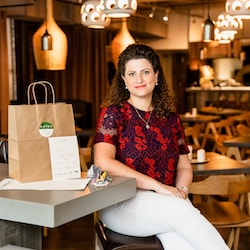 Tal Baum
“It was probably the hardest week in my career,” says Tal Baum, founder and CEO of Oliva Restaurant Group, which includes four Atlanta-based concepts: Aziza, Bellina Alimentari, Falafel Nation and Rina. “We were dealing with a lot of questions and uncertainty – and not a lot of information or guidance,” she recalls.
From a financial perspective as well as a public health and safety perspective, Baum made the hard decision to shut down completely. Restaurateurs in other locations with other types of concepts took different routes – shifting to delivery and to-go business models and, in one case, revving up a food truck and hitting the neighborhoods.
“We started tracking the impact on our sales March 16,” says Bill Goudey, owner of two Copeland’s franchises in Cobb County. “That’s when sales really fell apart.”
Because his locations are outside Atlanta city limits, Goudey didn’t have to shut the doors until a statewide mandate effectively closed dining rooms on March 24, with a shelter-in-place order following on April 3. Before then, he continued to operate with the exception of a three-day shutdown at his Cumberland location when an employee received what turned out to be a false positive COVID-19 test. Once the governor’s order came down, he shifted immediately to curbside pick-up and delivery.
In Savannah, the situation for The Gaslight Group owner Brian Huskey was much different. Three of his four locations, B. Matthew’s, Abe’s on Lincoln and The 5 Spot downtown, are in the city’s historic district. “With the hotels and offices shutting down, it was not going to make any sense to stay open for takeout or delivery,” he says. “There were no guests to serve.”
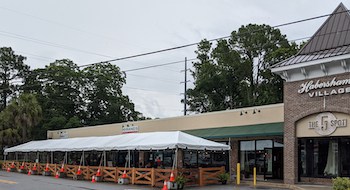 5 Spot partnered with neighboring restaurants to convert former parking spaces to outdoor dining space.
Huskey continued to do takeout and delivery from The 5 Spot location in midtown and pivoted to what turned out to be his ace in the hole: a mobile kitchen trailer. “The ironic thing is we’ve had it for five years, and in January, I was thinking about selling it,” he says. “We were able to get out into the Savannah neighborhoods and did close to $40,000 in sales in April and May – that was amazing.”
For Baum, one saving grace was the specialty market she runs out of Bellina Alimentari at Ponce City Market in Atlanta. “We import nonperishable items from Italy and sell on various channels online,” she says. “That business actually flourished during the quarantine. Everyone was in a home-baking mood and wanted yeast and flour.”
Baum says that stream of revenue allowed her to keep health insurance for employees who had been furloughed. Plus, she shifted her cooking classes online, even hosting a group from Kennesaw State University who had been scheduled to visit Italy this summer. “We had an afternoon together,” she says, “and I taught them how to make fresh pasta and pizza.”
Despite a few bright spots that helped generate revenue for restaurateurs, there were incredibly difficult decisions to make – furloughing employees, dealing with inventory, applying for loans and, for many, just staying in business.
The Business of Shutting Down
Estimates from the National Restaurant Association (NRA) reveal that among restaurants in Georgia that haven’t closed permanently, 84% have laid off or furloughed employees since March. Before the pandemic hit, the industry represented 15% of the state’s employment – more than 500,000 people – amounting to hundreds of thousands of people out of work.
Goudey opted to run his restaurants with only his management team – furloughing 190 people and cutting his manager’s incentive pay. At the Oliva Group, Baum furloughed the majority of her 120 employees, keeping a core team to handle her shipments from the Bellina market. As for Savannah-based Huskey? “We furloughed everyone – including myself,” he says. “I wanted my team to understand that we were all in this together.”
Then came the paperwork. Since the State of Georgia mandated that employers file partial unemployment claims on behalf of the employee, owners and operators got very busy, very quickly.
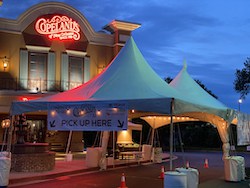 Copeland’s set up extensive to-go systems
“In the beginning, I couldn’t believe there was this additional workload while we were struggling to survive,” says Goudey. “But I came to realize after hearing nightmare stories from friends in other states that Georgia did it right.”
And in the midst of everything? There was the food. To state the obvious, closing a restaurant is not easy. And one of the first steps was getting rid of inventory.
“We organized a big market handout to all of our staff from the walk-in cooler,” says Baum. “I think we gave away produce and protein worth almost $30,000 between all the locations. It was a very hard day.”
Other owners and operators took the same path. At Copeland’s, Goudey emptied all of the perishables from their coolers and freezers and prepared about 900 family meals for their hourly crew to share with family and friends.
Sharing food to help others – a hallmark of Georgia restaurateurs – went beyond feeding employees. Across the state, donations were made to schools, homeless shelters, first responders, healthcare workers and charitable organizations.
One big plus for Huskey was his food truck. Since The 5 Spot location in Savannah’s midtown was still open for takeout, employees moved product there from his other locations, and “what we didn’t have room for, we left in the other brick and mortar coolers,” he says. “We basically had two commissaries to work out of, and as we emptied them, we turned them off.” At the height of the quarantine, Huskey joined forces with a dozen other food trucks to share contacts and coordinate bookings. Fortunately, he says, “What little money we had coming in from that one location was actually enough to float us and then some.”
For Copeland’s Goudey, he felt fortunate that he was able to stretch his 4th quarter reserves for almost two months after making some deals with vendors and negotiating late rent payments.
While the pandemic forced owners and operators to hit the cash flow pause button, a big part of survival mode was applying for Paycheck Protection Program (PPP) loans and SBA small business and economic disaster loans. Baum, who received her PPP loan during the second round of funding, says it definitely helped a lot.
“It is what enabled us to reopen our doors with some security in place knowing that the next few weeks would not be stable.” After applying for his loan, Goudey says, “That was probably the most frustrating 7 ½ weeks of my life – wondering – not knowing.”
The Rush for Technology and Training
From the beginning, restaurateurs were forced to take a hard look at what it was going to take to survive. One challenge was shifting to a strictly to-go and delivery business model, where in some cases, none really existed. Copeland’s had done curbside pick up and to-go for many years, but, says Goudey, “Not on that scale and not in that volume.”
He set up drive-thru tents with cones and signage, stationing attendants to receive guests. “We converted our entire business to a to-go model and spent a lot of time and effort trying to do it correctly out of the gate.”
And like a lot of other restaurants, Goudey rushed to get additional third-party delivery services onboarded. “It took almost three weeks,” he says.
In Savannah, Huskey had four third-party delivery services going at the same time. “We were already doing takeout at The 5 Spot, but nowhere to the extreme that we did during the time the dining rooms were closed.”
Although restaurants already adhere to standard food safety and sanitation rules, facing the multitude of new regulations that resulted from battling COVID-19 was a big undertaking. During the shutdown, owners and operators took advantage of industry resources from the Georgia Restaurant Association (GRA) and NRA, as well as state and local health departments and the CDC to stay on top of any developments that might affect the industry – and to keep their employees up-to-date.
“I felt it was my obligation to share every piece of information I had with the employees so they had an understanding of what was going on,” says Baum.
As plans to reopen started taking shape, plans for training employees to deal with the new rules took shape, too. Training for Huskey’s staff included sharing information from the GRA, the Georgia Department of Health and the Savannah-based Tourism Leadership Council, as well as holding a series of webinars on COVID-19 through restaurantowner.com. In Goudey’s case, not only did every employee have to complete the NRA’s food handler’s certification course, Copeland’s corporate group created three courses on safety and sanitation related to the virus, as well as a training video on the signs of illness.
Baum had a special advantage: a husband in the medical field. “There were a lot of health-related questions that I certainly didn’t have the answers for,” she says. With his council, Baum wrote a COVID-19 handbook to address new protocols and procedures “to adapt to the new reality that we are facing.” The Oliva Group staff then went through a two-week training process.
The Path to Reopening
Even though Georgia’s governor allowed dining rooms to reopen in late April, resistance from the industry was widespread. “We waited about 11 days after that,” says Copeland’s Goudey, “because there was very much a negative air about restaurants opening too early.” He waited to reopen Mother’s Day weekend – May 8, “which coincidentally happened to be the day we received our PPP funding.”
Baum didn’t open any of her locations until May 18 – and even then it was for curbside pick-up only. In June, she began staggered openings of her four concepts, one per week. “It’s like we were opening four restaurants on the same day,” she says.
Not only did locations have to meet mandates from the Governor’s executive order – like signage about the signs of illness and social distancing requirements – but owners and managers had to do everything from securing masks and gloves to implementing contactless payment, rearranging the furniture, expanding or creating outdoor seating, and even using throwaway menus. Not to mention letting potential guests know the doors were open again.
For large spaces like Copeland’s, where each restaurant seats between 295 and 310 guests, it was fairly easy to remove tables and restrict seating to every other booth. For Goudey, shifting on the fly included getting some technology solutions in place to meet the needs of guests “with that heightened awareness of safety and sanitation.”
He installed high-powered commercial UV germicidal and antibacterial air purification systems and added a Wi-Fi based payment system that connects to his POS system.
Other big changes that came out of the shutdown include removing the bakeries in the front of each location to accommodate the increase in sales from to-go orders and trimming menu items from 58 to 42 items. “That’s been an evolution as well. We’re trying to find creative ways to replace it,” he says, including offering popular buffet items à la carte.
In Savannah, Huskey reopened two of his three historic district locations in June – B. Matthews, which has two floors that make distancing easier, and his bar, Abe’s on Lincoln, where he pulled more than half capacity on the bar stools. As for The 5 Spot in midtown, in addition to dining inside, it’s hard to miss the 80-foot tent in the parking lot that he shares with two neighboring restaurants. “So far, that’s working pretty well,” he says. Huskey also added QR code menus that guests access with their iPhones. “You can’t order from it, but you call tell the server what you want.”
In the case of restaurants dealing with a pandemic, necessity isn’t only the mother of invention, it’s the stepping stone to greater efficiency measures and – for an industry that operates on razor-thin margins – cost-cutting measures. And while the ebb and flow of containing the virus and planning for the next ‘unknown’ continues, restaurateurs have already learned some valuable lessons.
Like other industry veterans, Goudey remains optimistic: “I know the rest of this year is going to be very challenging and difficult,” he says, “but I’m hopeful for the future.”



